From several manuscripts in the collection of the Royal Irish Academy, as well as elsewhere, it appears that the family of O'Hurly is of very ancient and noble Milesian origin. The first MS. to which I shall refer is the celebrated Book of Leacan, so called from Leacan, the hereditary residence of the antiquarians of Sligo, whose castle was situated near the river Moy, in the barony of Tireragh, County of Sligo. This MS. is a compilation from many more ancient historical MSS., such as the Psalters of Cashel and Tara, Book of Glendalough, &c., &c., and was written about the close of the fourteenth century. (A copy of this MS. was made by the writer of this notice by order of his late Majesty for the Royal Library, and which he had the honour to lay before his present Majesty in the year 1830 at St. James's Palace.)
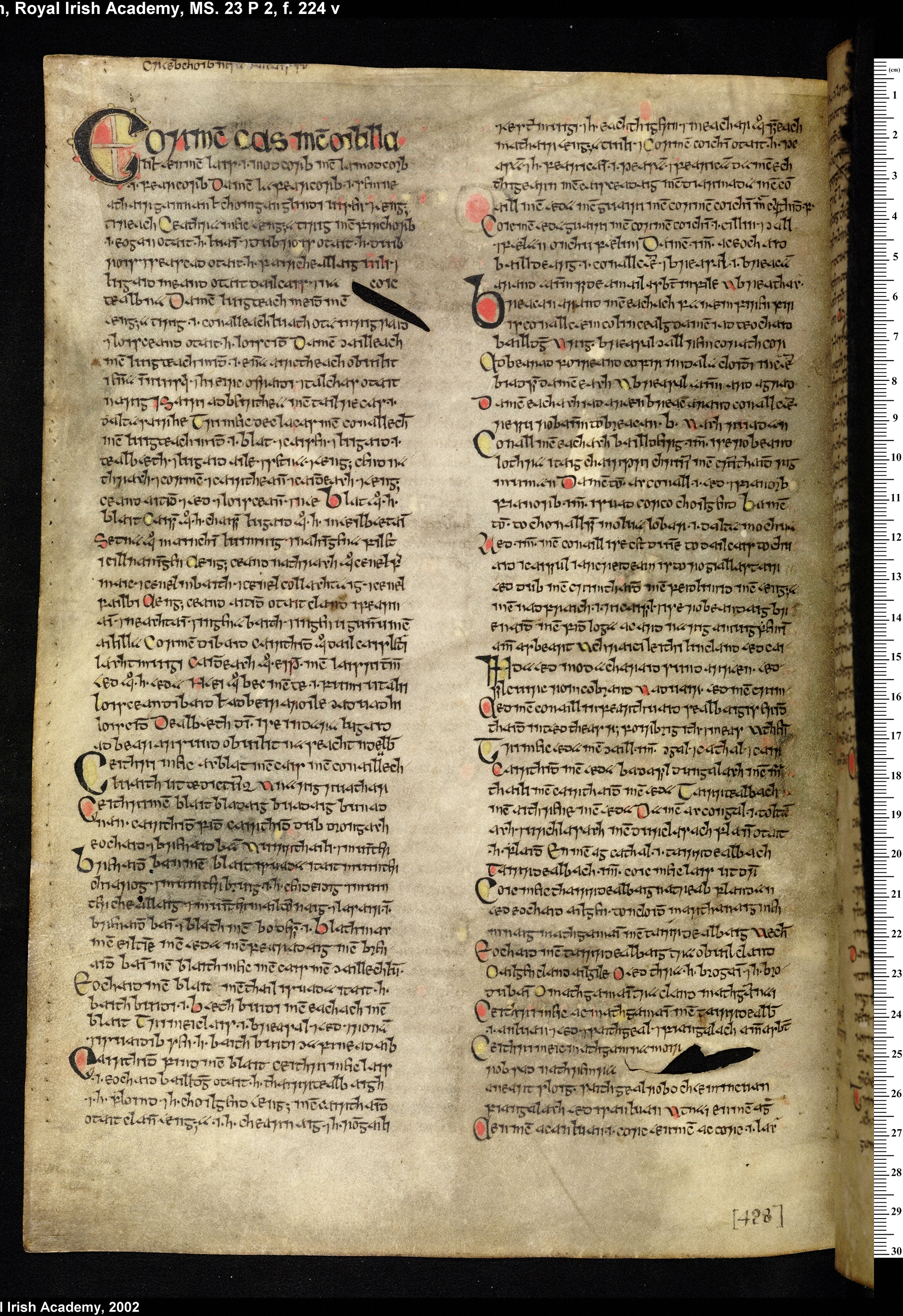
[p. 107] At folio 214, page B, of this MS. is the following account of the origin of the O'Hurly family as descended from the same stock with that of the Thomond family, viz.: "Cormac Cas was son of Oilioll Olum, King of Munster (lineally descended from Milesius) about the year 230. This Cormac Cas had one son named Fearcorb, who had two sons, viz., Semne and Aengus Tireach. Aengus Tireach had four sons, Eogan, Dubros, Leascad, Luigdeach Meand, the last-named had two sons, viz., Conall Eachluath (i.e., Conall of the swift steeds) and Lisceand. Conall Eachluath had two sons, namely, Enna Airgtheach and Cas, surnamed Tal (i.e., Cas Mac Tail) and hence the Dal Cassians of Munster). Cas had thirteen sons, of whom Blod was the eldest. This Blod had four sons, viz., Cairthean Fionn (the fair), the ancestor of the O'Brien family, afterwards Earls of Thomond; Cairthand Dub (the black), Eacho, and Brenann Ban (the fair), from whom are descended the O'Hurlys." From this account we find that the O'Briens and O'Hurlys concentrated in Blod, from whom the district of Aoibh Bloid took its name, according to O'Huidhrin, the Munster topographer, who lived about the year 1400. Dr. O'Brien, in his Dictionary, under the word Aoibh, says it is now the barony of Lower Ormond, but from several passages in other MSS. it is plain that it was situated in Thomond, now County Clare.
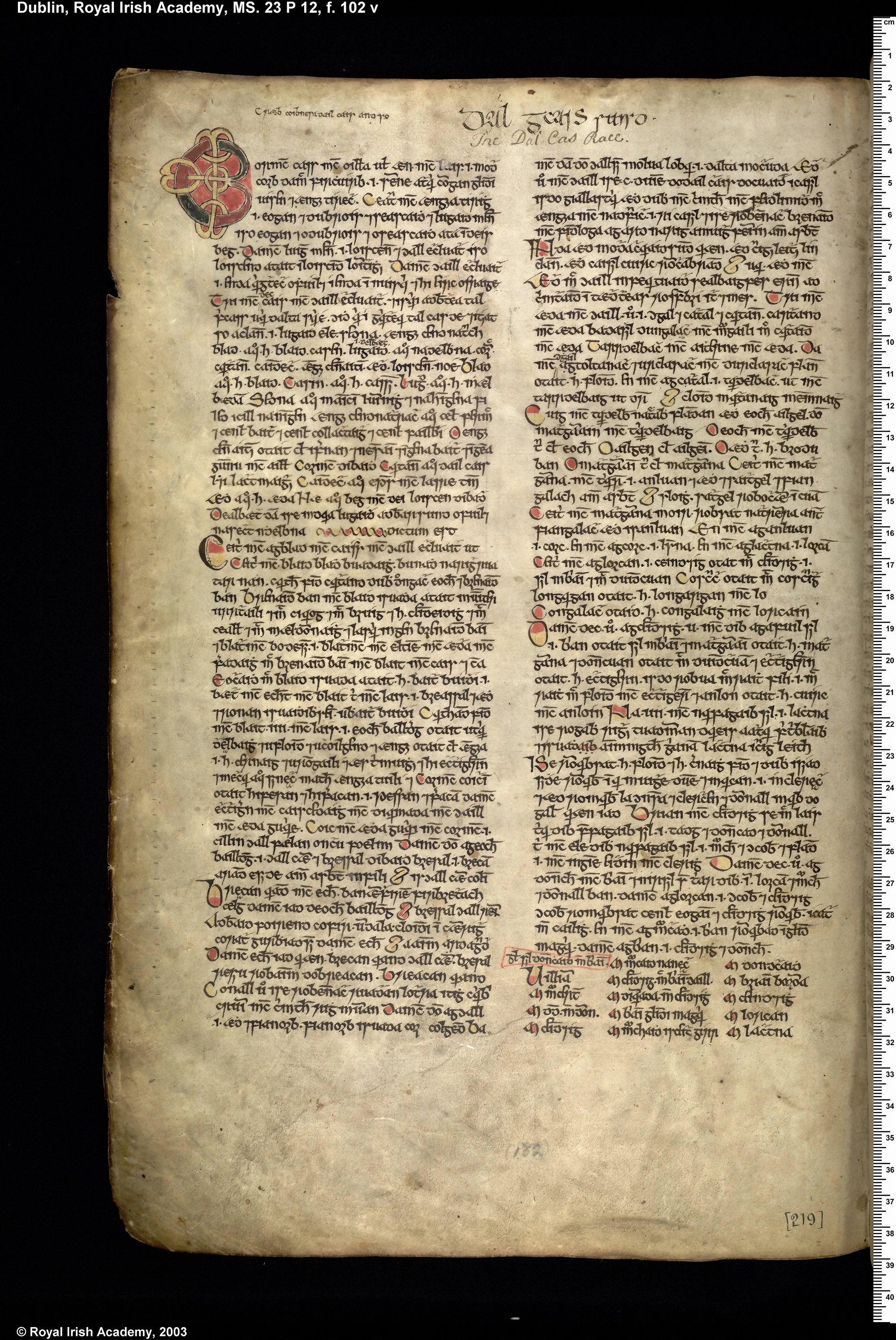
The foregoing account of the origin of the O'Hurly family is fully borne out by another MS. called the Book of Ballymote, which has, similarly with the Book of Leacan, derived its name from the place where it was compiled, namely, Ballymote, the ancient residence of the MacDonoughs, Princes of Caran, in the barony of Leyney, County of Sligo. This MS. was finished about the fourteenth century, and such was the estimation in which it was held, that in the year 1522 it was sold for 140 milch cows. The account of the O'Hurly family in this MS. is given under the heading of the "Dal Cas Race," at folio 102, page B. As it would be only a repetition of the foregoing, although evidently taken originally from different sources, it will not be necessary to insert it here.
The account of the O'Hurly family in the two MSS. is supported by several modern writers, as, for instance, O'Flaherty in his Ogygia, published in 1685, chap. 82, p. 387, makes them a family of Thomond, as does Dr. O'Brien in his English-Irish Dictionary under U; see also the Abbé MacGéoghegan's History of Ireland, vol. i., page 304, note, and Gratianus Lucius, cap. 3.
It now remains for me to trace the family of O'Hurly from Blod, their common ancestor with that of the Thomond family, down to about the middle of the seventeenth century, which I shall extract from an Irish MS. by Dudley McFirbis, the last historiographer of Leacan, who was murdered in the year 1670. It was under his tuition that O'Flaherty, the author of Ogygia, studied; and McFirbis himself studied under McEgan, the last of the hereditary Brehons of Ireland, who, I believe, resided in the County Tipperary.
[p. 108] McFirbis was highly esteemed as an antiquary by Sir James Ware, who employed him in all matters of doubt and difficulty; he was also thought highly of by Charles O'Connor, who in his correspondence with the Chevalier O'Gorman states that McFirbis was a man of great research and discernment, and that he considered him an unquestionable authority on Irish History and Family Genealogies. This MS. is a thick quarto volume of 800 pages, and is the property of the Earl of Bowden. It is at present at the Royal Irish Academy for the purpose of having a copy of it made for the library. It has been settled beyond contradiction that the genealogies of 110 families were regularly kept, besides those of the Kings, Chiefs, and Princes, who were able to retain their bards for that especial purpose, and there can be no better proof that the O'Hurlys were chiefs than that their genealogy was regularly kept to so late a period, which I shall show by a comparison in parallel columns of the O'Brien with that of the O'Hurly, which is the general criterion by which all the Munster families are put to the test; just as the Ulster and Connaught families are tested by that of the O'Neills, because those were the two principal families in the kingdom, and their genealogies are unquestionable.
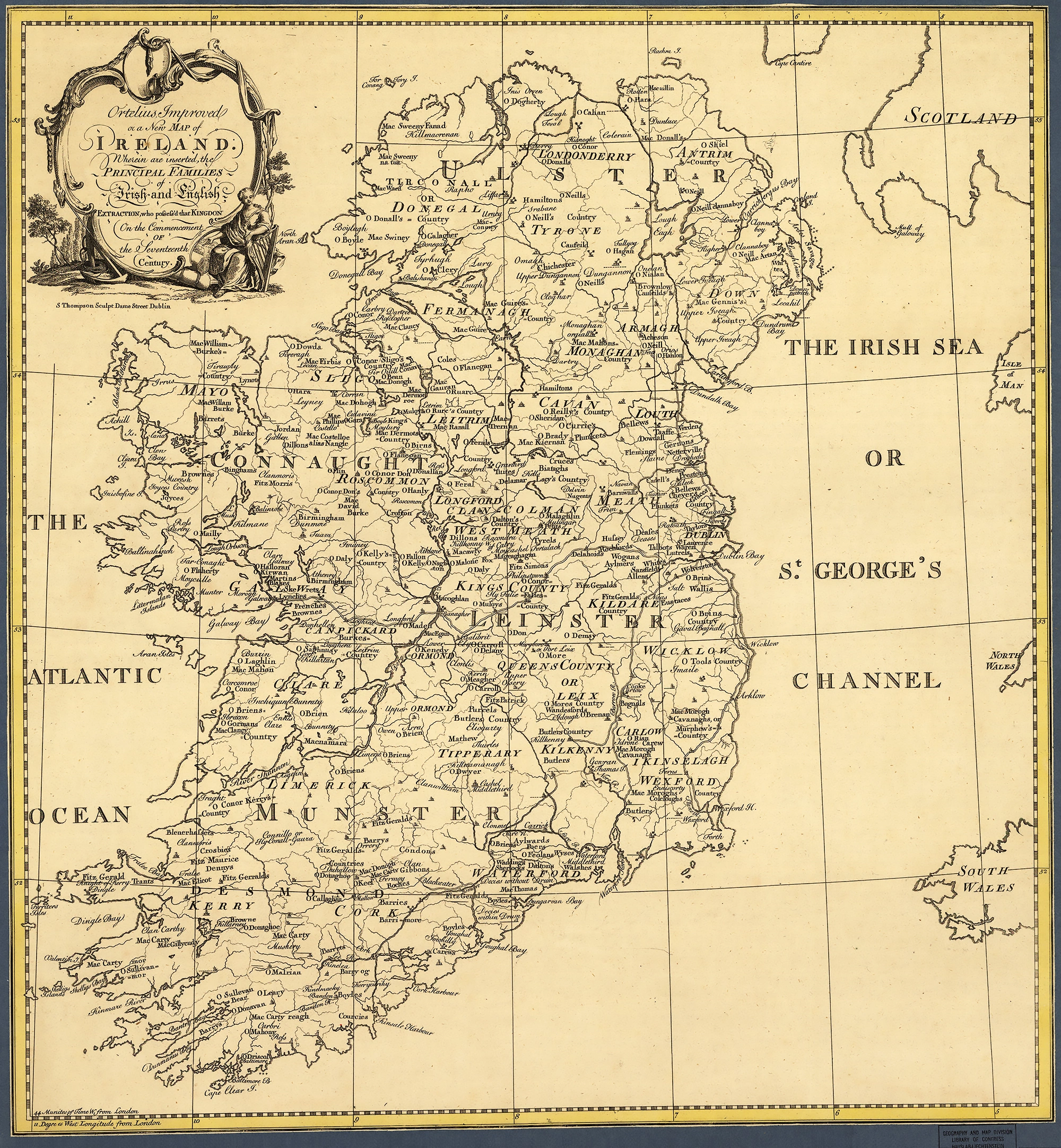
By various connecting circumstances it is established beyond dispute that the genealogy which is given as underneath from McFirbis is that of the O'Hurlys of the O'Brien branch, whose ancient possessions are marked out by O'Connor on his admirable map of the districts possessed by each chief. It is distinctly shown to be on the borders of Tipperary, adjoining the Limerick district of the O'Briens. Its ancient name was Druim Damaghaire, but it is now called Knocklong, and is situated in the barony of Coshlea, the most south-east barony in the county.
Adjoining this place, on the hill of Knocklong, are the ruins of a castle, formerly the residence of Sir Thomas Hurly, whose monument stands in the church of Emly, sixteen miles south-west of Cashel. This Sir Thomas is supposed to have been related to Thomas Hurly, Bishop of Emly, who died at an advanced age, A.D. 1542. But it does not appear that Sir Thomas was chief of his tribe; on the contrary, we have reason to think he belonged to a minor branch of the family.
The bracketed page citations above ([p. 107], [p. 108]) mark the original page breaks; spelling, italics, and punctuation otherwise follow the 1905 printing, including "1670" for McFirbis's death (modern scholarship gives January 1671, a discrepancy explained by the Old Style calendar, under which the new year did not begin until March 25th — so a contemporary writing in "January 1670" and a modern writer giving "January 1671" can both be describing the same date).
The Book of Leacan folio citation above ("folio 214, page B") almost certainly refers to an older or different foliation scheme than the manuscript's modern standard numbering — a folio we examined at the modern f. 214v does not match this content. The Book of Ballymote citation ("folio 102, page B"), by contrast, checks out precisely: f. 102v of that manuscript is headed exactly as the article describes, "the Dal Cas Race" (Dál Cas Fine) — see the illustration above.