5. The Knocklong Branch: Bishops, Castles, and the Confederate & Williamite Wars
Journal of the Cork Historical and Archæological Society, Vol. XI, 2nd Series, No. 67 (Jul–Sep 1905), pp. 109–110
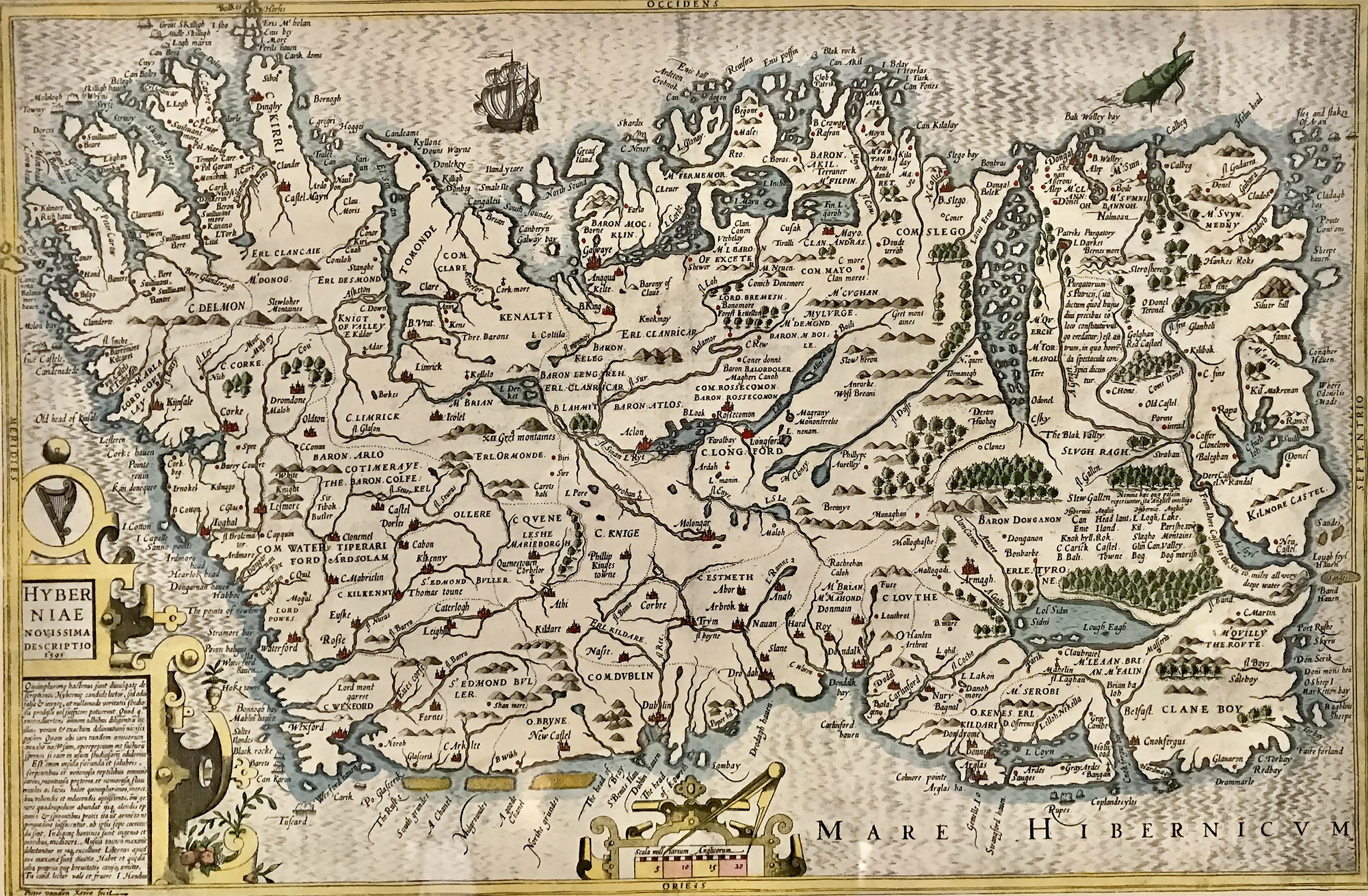
Pieter van den Keere, map of Ireland, 1591. Click to enlarge.
This page follows the Knocklong sept through two Emly bishops, four family-associated castles (including Archbishop Dermod O'Hurly's birthplace), and the baronet succession from Thomas Hurly of Knocklong through the Confederate Wars, the Williamite War, and Sir John Hurly's eventual exile to Rome.
Page 109 (cont.)–110
This Knocklong branch gave two Bishops to the church of Emly and several clerics. Thomas, Bishop from 1507–1542; Maurice, Bishop from 1620–1649. Thomas was a very eminent Canonist. In 1543 King Henry VIII. presented Donogh Ryan chaplain to the Deanery of the Cathedral of Emly, vacant, inasmuch as William McBryen and William O'Hurley, the present incumbents, hold the same by the authority of the Bishop of Rome. In 1609 King James presented Edmund Hurly, notwithstanding his "minority and defect of clerical orders," to the Chancellorship of that Cathedral, with a corps of vicarages united, and in the same year, and under similar disqualifications, to the Chancellorship thereof.—Patent Rolls, Jac. I.
Besides Knocklong, the chief residence of the Hurly sept, who also founded a church here, in the parish of Kilruane, Lower Ormond, County Tipperary, is the ruined castle of Rathurly; in the parish of Kilcullane, Co. Limerick, where they erected the castle of Kilcullane in 1641; in the parish of Killonahan, in the same county, where Dermod O'Hurly built a strong castle in the early part of the fifteenth century. Archbishop Dermod O'Hurly was born in the castle of Lycadoon, near Limerick.
Thomas Hurly, of Knocklong, attended Perrot's Parliament in Dublin. His son, Maurice, obtained a patent for a weekly market on Tuesdays, and two fairs to be held on the 28th of May and 1st October. In 1632 he erected a fine marble monument to the memory of his two wives, whom he survived. His son, Sir Thomas, Baronet, succeeded him, and was one of the Confederate Catholics at Kilkenny in 1647. His estates were forfeited in the counties of Limerick and Tipperary for his adherence to Charles I., and given to Cromwell's adventurers, and he was transplanted to Connaught, where he died in 1683, leaving a son, Sir William. He attended King James's Parliament in 1689 as representative of the borough of Kilmallock. He was actively engaged in scouring the country with Lord Brittas, and at the engagement of Thomond Gate, siege of Limerick, Colonel Hurly was with others taken prisoner. He died soon after of his wounds. His infant son, Sir John Hurly, claimed his transplanted Galway estate, which was forfeited to Bryan O'Bryen, who had married his mother, but the claim was dismissed, and the estate sold to Thomas O'Connor, Sir Thomas Montgomery, and the Hollow Sword Blade Company. He tried to raise troops for the Pretender, and was arrested in Dublin about the year 1714, but escaped; and likely, after many vicissitudes, escaped to Rome, where he died.
No page-break is marked in the original printing within this stretch of text, so the "Page 109 (cont.)–110" heading above is an estimate based on surrounding pagination rather than an explicit citation; the next bracketed page-marker in the source text appears at the opening of Section 6. Spelling, italics, and the "—Patent Rolls, Jac. I." citation style otherwise follow the 1905 printing exactly. We have also logged, but not yet independently verified against the underlying scanned pages, an outside source (Caulfield & D'Alton, "Notes on the Cathedral of Emly and the Family of Hurly") that appears to trace this same baronet succession and the Emly monuments independently — worth returning to before treating every date below as final.
Historical Note — Pieter van den Keere's 1591 Map of Ireland
Pieter van den Keere (also written Petrus Kaerius), a Dutch engraver working in London and later Amsterdam, published this map of Ireland in 1591 — one of the earliest reasonably detailed printed maps of the island, based largely on surveys associated with the Elizabethan cartographer Robert Lythe. It predates the Confederate and Williamite wars covered later on this page by half a century and more, but it sits close in time to this section's earliest dated event, Thomas Hurly of Knocklong's attendance at Perrot's Parliament in 1585 — making it a near-contemporary snapshot of how Ireland's counties, baronies, and lordships were understood right around the moment the Knocklong sept first appears in the documentary record the article follows. As with the O'Conor and Ortelius maps discussed in Section 3, we have not attempted to locate a specific Hurly holding on it; it's included here as period context for the territory rather than as a citation the 1905 article itself makes.
Historical Note — The Two Bishops of Emly
Thomas Hurly, given here as Bishop of Emly from 1507 to 1542, is the same figure whose 1542 death date Section 3's critique note already questioned — independent research turned up a Thomas Hurly consecrated to Emly around 1501–1502, but the only firmly dated 1542 event we could independently confirm at Emly was the deposition of a different man, Dean William O'Hurly, for holding his post under papal rather than royal authority. That uncertainty carries over here rather than being resolved by it. Maurice Hurly, Bishop from 1620 to 1649, is new to this section: his episcopate spans almost the entirety of the Confederate Wars period covered later on this page, meaning a Hurly held the diocese of Emly itself through the Confederation of Kilkenny, the Cromwellian conquest, and the family's own forfeiture and transplantation — the same upheaval Sir Thomas, a few lines on, lived through as a layman and Confederate Catholic.
Historical Note — Four Castles, and the Birthplace of Archbishop Dermod O'Hurly
The article names four Hurly-associated castles in quick succession: Rathurly, in Kilruane parish, Lower Ormond, Co. Tipperary; Kilcullane, built in 1641 in Co. Limerick, on the eve of the wars that would cost the family so much of what it held; Killonahan, also in Limerick, built in the early fifteenth century by a Dermod O'Hurly; and Lycadoon, near Limerick city, named here only as a birthplace. That last name belongs to Dermod O'Hurly, Archbishop of Cashel, one of the best-attested and most significant figures this family produced — executed in Dublin in 1584 under Elizabeth I and venerated since as one of the Irish martyrs of the Reformation period, beatified in 1992. This is only his first, glancing appearance in the article; Section 11 is dedicated to the fuller story of his life, arrest, and death, so we hold most of that account for there rather than front-loading it here.
Historical Note — the Confederate Wars and the Transplantation to Connacht
Sir Thomas Hurly's career maps almost exactly onto the upheavals of mid-seventeenth-century Ireland. The Confederation of Kilkenny, which he joined in 1647, was the Irish Catholic assembly formed after the 1641 rebellion to govern Confederate-held territory and negotiate, unsuccessfully in the end, for religious and political concessions from the crown — while nominally supporting Charles I, the cause Sir Thomas's own descendants would later describe, in the family lament quoted in Section 2, as one that ruined them "even by their fidelity." Its defeat by Cromwell's forces in the early 1650s led directly to the Act of Settlement, under which Catholic landowners judged insufficiently loyal to the crown had their estates confiscated and granted to Cromwellian soldiers and financial "adventurers" who had funded the war, while the dispossessed were nominally offered replacement land west of the Shannon in Connacht — the policy remembered in the phrase "to Hell or to Connaught." Sir Thomas's own transplantation there, and death in 1683 still in exile from Limerick and Tipperary, is one small, well-documented instance of a policy that reshaped Catholic landownership across Ireland.
Historical Note — Sir William and the Siege of Limerick
Sir William Hurly's death is placed at the Williamite siege of Limerick in 1690–91, at an engagement near Thomond Gate, the fortified crossing of the River Shannon into the city's Englishtown. As with Archbishop Dermod O'Hurly above, this is a first, brief mention of events Section 11 covers in full — that section's title names both the Williamite War at Thomond Gate and the Archbishop's martyrdom together, so the fuller military narrative and its sourcing are held for there.
Historical Note — the Hollow Sword Blade Company
The purchaser of Sir John Hurly's forfeited Galway estate, alongside the named individuals Thomas O'Connor and Sir Thomas Montgomery, was the Hollow Sword Blade Company — nominally an English manufacturer of sword blades, but by the 1690s functioning mainly as a land-speculation and banking concern. It became the principal purchaser of confiscated Irish Jacobite estates sold off by the English Parliament after the Williamite War, buying up land cheaply and reselling it in smaller lots, before the company's directors went on to found the South Sea Company in 1711 — the vehicle for the South Sea Bubble of 1720, one of the eighteenth century's most notorious financial collapses. Sir John's own later arrest, escape, and reported death in Rome fits a well-documented pattern: Irish Jacobite gentry who had lost their estates in the settlement continuing, a generation on, to recruit or intrigue for the exiled Stuart cause from the continent, at real personal risk when they returned to Ireland to do it.