Journal of the Cork Historical and Archæological Society, Vol. XI, 2nd Series, No. 67 (Jul–Sep 1905), p. 112
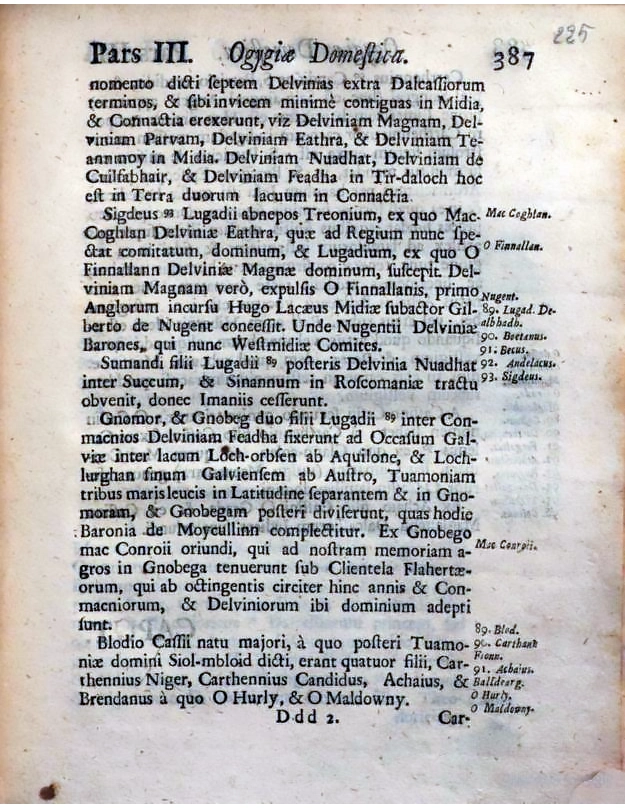
Roderic O'Flaherty, Ogygia, seu Rerum Hibernicarum Chronologia (1685), Pars III, "Ogygia Domestica," p. 387 — the O'Hurly name is visible in the printed text. Click to enlarge.
This short page quotes the medieval poet O'Heerin's verse on Hy Bloid, the O'Hurlys' own tribal territory, then briefly surveys the family's later branches — Limerick, Galway, and the Archbishop of Cashel among the O'Hurlys of Limerick — citing Owen Connellan's 1846 translation of the Annals of the Four Masters as its source.
Page 112
The O'Hurlys are of the Dalcassian race, and are stated in O'Flaherty's Ogygia to be of the tribe of Hy Bloid, who possessed the territory called Triocha Hy Bloid, which comprised a great part of the barony of Lower Ormond and Owney in Tipperary. Their tribe was also designated Clan Tail, a term which was applied to the Dalcassians. The O'Hurlys are thus mentioned by O'Heerin:—
"The territory of Hy Bloid, of the silken standards;
The chiefs of conflicts, leaders of the battle hosts;
The tribe of Clan Tail, as far as the limpid streams,
Along the extensive plain of the Yews,
O'Hurly of the tribe of Tail,
Near to Killalue of St. Flannan.
Delightful are its woods and protective its plains,
From thence westward to the Shannon."
A branch of the O'Hurlys also settled in Limerick, where they are placed in the map of Ortelius, and they also had the parish of Knocklong, in the barony of Coshlea, where the ruins of their chief castle still remain. Other branches of the O'Hurlys were settled in Galway, and had large possessions in the baronies of Kilconnell and Killian and Ballymore, of which family were Sir William and Sir John Hurly, Baronets. Of the O'Hurlys of Limerick was Dermod O'Hurly, a celebrated Archbishop of Cashel in the reign of Queen Elizabeth. There are still several respectable families of the name in the Counties of Limerick, Tipperary and Kerry.—Annals of Ireland, translated from the original Irish of The Four Masters, by Owen Connellan, Esq., page 199.
Spelling and punctuation follow the 1905 printing exactly, including "Killalue" (Killaloe, Co. Clare, the seat of St. Flannan's Cathedral) and "Triocha Hy Bloid." The poem is set as verse here, following its own line breaks in the original printing, though it is presented there as a prose quotation with internal punctuation rather than typeset as poetry proper; the line breaks reproduced above match the sense-units of the original lineation.
Historical Note — Giolla na Naomh Ó hUidhrín and the Topographical Poems
"O'Heerin" is Giolla na Naomh Ó hUidhrín, a Connacht poet who died in 1420 and who continued a topographical poem begun a generation earlier by Seán Mór Ó Dubhagáin, chief poet to the Uí Cheallaigh (O'Kelly) lords of Uí Mháine. Together the two poems form a versified survey of the chief Gaelic families and their territories across Ireland, county by county — Ó Dubhagáin covering the northern half of the country and Ó hUidhrín the southern, including Munster, where the O'Hurlys appear. The composite work was edited and translated by the great nineteenth-century Irish scholar John O'Donovan as The Topographical Poems of John O'Dubhagain and Giolla na Naomh O'Huidhrin (Irish Archaeological and Celtic Society, 1862), which remains the standard edition. This article already named "O'Huidhrin, the Munster topographer, who lived about the year 1400" in passing back in Section 3, when citing him as the source for the district-name Aoibh Bloid; this is the poem itself, quoted directly rather than merely cited.
This passage's citation — Owen Connellan's 1846 translation of the Annals of the Four Masters, page 199 — can be independently checked, and largely holds up well. The relevant page is part of an appended catalogue Connellan compiled of the chiefs and clans of Ormond, in which the O'Hurly entry (numbered "IV" in his sequence, between III. O'Kennedy and V. O'Eichtighearn/O'Higgin) supplies real independent detail beyond what this article quotes: it places a Limerick branch specifically in the barony of Owneybeg and "on the Map of Ortelius" (a second, separate period map reference, distinct from Charles O'Conor's 1777 Ortelius Improved discussed in Section 3), repeats the Knocklong/Coshlea holding, and gives the same Galway branch (Kilconnell, Killian, Ballymore, "sir William and sir John Hurley baronets") and the same identification of Archbishop Dermod O'Hurly as "of the O'Hurleys of Limerick" that this article's own text carries. So far, this looks like a faithful, checkable citation — a rarer thing in this series than one might hope.
Connellan's own catalogue entry adds one further detail this article leaves out: he gives "Ó Toirdhealbhaigh" as an alternate form of the family name, which he reconciles with "Ó Urthaile" — the same Urthuile named in Section 4's pedigree as the family's actual namesake — anglicised O'Hurley. It's a reminder that the surname's documentary trail is a little more tangled than the article's own tidy pedigree table lets on, with more than one manuscript-tradition spelling converging on the same family.
A Note on Hy Bloid and Clan Tail
Hy Bloid (Ibh Blod, Uí Bhloid) is the same territory and tribal name discussed at length in Section 6's note on the Wars of Turlough manuscript, where independent fourteenth-century sources confirmed it as a real, active political grouping east of the Shannon in the early 1300s; nothing here changes that picture, so we won't repeat it in full. What's new on this page is "Clan Tail," given here as another name for the same Dalcassian grouping, from Cas (Tál), the common ancestor named at the head of Section 3's pedigree tables. "Triocha Hy Bloid," the territory's formal name, likely preserves the medieval Irish land-unit trícha cét ("thirty hundred(s)"), a standard administrative division of early and later medieval Ireland roughly equivalent to the Anglo-Norman "cantred" — the same unit of measure, incidentally, used to describe Conor Oge O'Hurly's land in Section 6's Hardiman deed ("the cantred of the Calaidh, or Challagh"). Two different documentary traditions, in other words, are describing O'Hurly landholding using the same underlying kind of territorial unit, decades or centuries apart.
A Note on the Galway Baronets — One Family, or Two?
This page's mention of "Sir William and Sir John Hurly, Baronets" as heads of an established Galway branch, holding "large possessions in the baronies of Kilconnell and Killian and Ballymore," sits a little uneasily beside the Sir William and Sir John this article has already introduced in Section 5, and will trace in full in Sections 9 and 12: the Knocklong, Co. Limerick baronets, forfeited and transplanted to Galway only after 1641, whose Sir William died of wounds at Thomond Gate in 1691 and whose infant son Sir John later fled to Rome. Those are the same two names, in the same generation, associated with the same county — but this page's language ("were settled in Galway," "had large possessions") reads more like a long-established Galway family than like refugees recently granted transplanted land. It's possible this is simply loose phrasing describing the same transplanted Knocklong baronets after the fact, once Galway had become their home; it's also possible Connellan's source material (see the note above) is describing a genuinely separate, older Galway sept that happened to produce baronets of the same name a generation or two earlier or later. We haven't been able to resolve this from the text alone, and flag it here as a genuine point of uncertainty rather than assume the two are the same family.
Glossary
Dalcassian
Anglicization of Dál gCais ("the people of Cas"), the dynastic federation descending from Cas, son of Conall Eachluath, that rose to dominate Thomond and, under Brian Boru, all of Ireland. The O'Briens, O'Hurlys, O'Molonys, O'Kennedys, and MacNamaras are among the septs claiming Dalcassian descent.
Trícha Cét
Literally "thirty hundred(s)," a territorial and military assessment unit used in medieval Ireland, roughly the scale of a modern barony and generally considered the rough equivalent of the Anglo-Norman "cantred." Neither unit corresponds exactly to any later administrative division, which is part of why identifying precisely which townlands a given trícha cét or cantred covered can be difficult today.